
Understanding what you need from your camera before you go
Before knowing what camera is the best one to take trekking you first need to answer when, how long and where you will be trekking. Then ask yourself why you want to take photographs?
At A Glance
What camera should you take trekking in Nepal in 2026?
Best All-Rounder
Canon Rebel / Nikon D5xxx series or mirrorless (Sony A6xxx / Fuji X-Txx) with an 18-135mm or 24-105mm lens.
Must-Haves
2-3 spare batteries + fast dual charger + dry bag + lens cloth + extra memory cards.
Leave at Home
Tripod (unless you have a porter), multiple heavy prime lenses, drone (permits required).
Phone Only?
Flagship phones (iPhone 16/17 Pro, Samsung S24/S25 Ultra) work for social media – but bring a 10,000mAh+ power bank (check airline battery restrictions) and expect 50-70% battery loss below -10°C.
Battery Rule
One battery per 2 days of trekking, plus one extra. Mirrorless needs more spares than DSLRs. Aim for under 1.5kg for your camera kit (body + lens + 2 batteries + charger).
When are you going?
This is important to know due to weather. Between December and February it can get brutally cold up in the mountains. So, you'll need to think about keeping your equipment warm. Ditto for getting your camera dry during monsoon season and dust free the rest of the year.
The above battery times are based on averages. Rule of thumb: bring one battery per 2 days of trekking, plus one extra.
How many days will you be trekking?
The primary reason you need to know how long you'll be trekking for is down to charging your batteries and how many spare batteries you'll need. While charging is possible it's not always available. Moreover in some more remote teahouses the solar batteries they use for light cannot handle battery charging beyond USB voltages.
Where will you be photographing?
Are you planning to go trekking at high altitude? Is your trek going to take over three weeks? Or are you only going for a week? Knowing how long and where you'll be going is essential to choosing the right equipment. Battery charging, lenses and equipment weight will all need to be considered here.
Why are you taking photographs?
Sounds silly but it's important. Are you planning to sell your photographs? Take specific shots? Or are you just going on a trip of a lifetime and want to capture the moment? If this is your professional work then tripods, backups and a whole lot more need to be considered. Maybe even porters. Otherwise you might want to lessen the weight and enjoy the trek more.
We won't be covering mobile phone cameras here. While new phones can take a nice photo for social media etc, for anything more they don't match the capabilities of dedicated cameras. Moreover, zoom lenses really work well for Nepal. It's also worth pointing out the lack of 4G or internet on many treks.
Once you've worked out the When, Where and Why you should now know what you are expecting from your camera and your equipment. e.g. there's no point in taking your Canon 1D with 5 prime lenses and two tripods on a 5 day trek to Poon hill in the middle of monsoon season without a dry bag or spare battery.
Let's move on and put more of this puzzle together so you can better understand what to expect out there, what's available and what's not going to work at all!
Camera Tip
Batteries hate the cold. Make sure to keep your camera batteries above freezing when you trek. Your inner pockets are often a good place!
Altitude / temperature effects on cameras and batteries when trekking
Optimal camera temperature ranges vary as do battery temperatures. I won't get into the technical side of things as I will discuss my own experiences with camera and battery temperatures when trekking in Nepal. Suffice to say on a Nikon D300 there's a listing saying 0°C to +40°C (+32°F to +104°F). Now let's move on into the real world.
I can positively say that I've never had a problem nor seen a problem with altitude and cameras. For other equipment: there are those that say the old spindle driven backup portable hard drives won't function over 4000 meters. Mine did. Now let's move on to the real issue - the weather.

Remember above when I mentioned "when" as a prerequisite for knowing about what camera to take to Nepal? This is why. If you are going trekking in the winter then it's going to get very cold. How cold? Well I've been in -45 with wind chill. During my winter Everest Base Camp trek it reached -15 indoors with snow outside.
How cold can it get before your camera stops working? No idea. I met some Koreans at -23 whose Canon Rebels stopped working. I met a girl in Kathmandu whose Olympus compact shutter jammed at +5. I met a Nikon user whose camera jammed at -10.
Truth of the matter is most camera malfunctions during the cold are caused by the batteries ceasing to function.
You'll also notice that batteries won't last as long in the cold either.
Keeping your equipment warm: I keep my batteries and camera close to me all the time. I trek with it a shoulder holster under my jacket and batteries in my inner pockets. Yes, it can get extremely uncomfortable, but I've never had a problem.
If you sweat a lot do be aware of freezing condensation.
The next biggest problem I came across were compacts, lens, and cameras getting so much grit and dust into their shutters etc, they just stopped functioning. DSLRs also suffer from this. Dirt and dust is everywhere in Nepal, including the mountains. I literally place my camera in a waterproof bag to protect it. I do not simply leave it hanging from my neck or shoulder exposed - it's simply asking for micro fine particles to get inside. This is particularly true of lenses. I've been there, and experienced that. Not even some of the best camera workshops have been able to remove everything from inside the lens housing.
Finally there's the old problem of moving a lens from a warm room to the cold and the condensation building up. If you are staying in a very warm guesthouse or by a fire then you need to keep your camera back a bit and be prepared for it to fog up.
Lastly there was one photographer who was convinced his DSLR shutter jammed in the cold temperature. This could happen, but I've not come across it that much.
My solutions to keeping your camera gear working in the cold: The best results I personally ever had was to keep my camera, battery and lenses as close to body temperature as possible.
- Keep your camera in a shoulder holster under your jacket.
- Store spare batteries in inner pockets (chest warmth works best).
- Carry a small Ziploc bag to prevent condensation when moving between cold and warm.
- Turn off image preview and GPS to save battery.
I also carry plenty of spare batteries and memory cards.
Charging your batteries and cameras when trekking
Most of the treks in Nepal will have guesthouses with electricity. Again if you really are going into remote areas then you'll need to be prepared beforehand with spare batteries.
Guesthouses do however require payment for the charging of any types of battery. It's very rare to find a power point in your room unless you are paying for private rooms. Most are located in reception.
In remote treks electricity is usually solar, and the power points are often just USB sockets. Something to keep in mind if you need something else.
Again, the moral of the story is to bring backup batteries and if possible fast chargers.
What camera to take trekking in Nepal?
As you've read I've made a point at not recommending specific cameras. Lots of reasons for that. Specifically the rules of When, where and why. But also because there are new cameras out every 6 months. And if you are here, you probably already know what you want in terms of your own more frequent photography needs.
The real recommendation on what camera to take when trekking is going to be based on your own needs.
I've seen everything from Canon Rebels to Nikon D4's, small mirrorless cameras, and mobiles being used when trekking in Nepal.
If you don't have a camera then you might consider the following
Mobile, DSLR or Mirrorless.
Mobile: Nepal is a once in lifetime opportunity for fantastic photos. Personally, I would avoid the pitfall of using a mobile phone as your sole camera. Mobiles are great for selfies and social media, but for zooming in, high resolution e.g. printing or viewing on a big screen they don't do justice to a photograph.
DSLR: Canon and Nikon are the main makers you should consider for what you might recognise as the standard big camera. They come in entry, mid-range and high-end ranges. You'll need a couple of lenses too. So their biggest drawback is weight and bulk. But, in return you get the best images. Batteries are a big plus here too as they last a long time (good for mountains). Both have lots of accessories and repair shops know the brands well.
Mirrorless: These cameras are becoming more and more popular the world over. They are able to produce amazing photographs with none of the bulk or weight that DSLRs have. The main problem with them is expense, they are much smaller and can be fiddly. But perhaps most importantly for trekking is that they consume a lot of battery power. One charge may only last about 3-4 hours while a DSLR could give you days. In the mountains, that last point is important.
My recommendation is to first and foremost understand when you are going, how long you'll be trekking, where you are going and why you are taking photos.
I will say if you plan on photographing inside monasteries or guesthouses then you'll need a camera and a lens with good low light capabilities.
When out above 4000 meters things tend to get bright - white (snow) and blue (sky). If it's just before the monsoon season things might get a little hazy too. Other than that dealing with light will be your main issue.
Remember if you are trekking at altitude you'll be dealing with a lot more than what setting to put your camera on. Altitude sickness and the effects of it are serious. It can have a serious effect on your concentration! Do read about altitude sickness before you go trekking.
You'll also be outside on the move nearly every day. The idea of shooting only in the magic golden hours for most trekkers is reserved for wherever you'll be waking or sleeping that day.
After that, the following list of recommended equipment might help too!
Mobile phone cameras for trekking in Nepal - pros & cons
Yes, flagship phones today (iPhone 16/17 Pro, Samsung S24/S25 Ultra, Google Pixel 9/10 Pro, Xiaomi 14/15 Ultra, etc.) take genuinely impressive photos, and every year the gap narrows. Many trekkers now use only their phone and come home perfectly happy. But "perfectly happy on Instagram" is not the same as "perfectly happy with big prints or in tricky mountain light". One day, you might like to print out a big print of trek highlight for a wall. Here's the real-world breakdown based on my own experience.
Bottom line:
If your goal is light travel, social media, and memories → a latest-generation flagship phone is absolutely good enough and many people now trek with only that.
If you want large prints, serious wildlife/portrait shots, or the absolute best monastery interiors and sunrise shots above 5,000 m → you still want a dedicated camera with at least one good lens.
Here's an insider tip: iPhone/Samsung as main camera + a tiny mirrorless (e.g. Sony ZV-E10 II, Canon R50 or Fujifilm X-S20) with a 24-105 mm or 16-55 mm lens as the "step-up" body for the shots that matter.
Real-world mobile phone tips for trekking in Nepal
Battery management is everything. A flagship phone at -5°C can drop 50% battery in 30 minutes of active use. My advice: keep the phone in an inner pocket, not a backpack side pocket. Use low power mode from the moment you leave the teahouse. Turn off Bluetooth, Wi-Fi scanning, and background app refresh. Bring a 10,000 mAh power bank (20,000 mAh if you also charge a camera but check airline restrictions). Many teahouses now have USB charging points, but they're often slow (1A). A power bank lets you charge overnight.
Camera app settings for mountain light. Auto mode struggles with snow and shadow. Switch to Pro or Manual mode if available – lock ISO to 50-200 in bright snow, keep shutter speed above 1/500s. Use exposure compensation: dial down -0.7 to -1.0 EV to avoid blown highlights on snow. Shoot in RAW (Apple ProRAW on iPhone, Expert RAW on Samsung) – you'll thank yourself later when recovering shadow details.
Lens attachments? Clip-on wide or tele lenses are mostly gimmicks – they reduce image quality and fog up easily. The only one I'd consider is a small anamorphic lens for video, but frankly, the built-in 5-10x optical zooms on flagships are better.
Protection from dust and moisture. Your phone case is not a dry bag. Fine Himalayan dust will get into charging ports and speaker grilles. Use a simple zip-lock bag with a hole cut for the lens – it's cheap, effective, and lets you use the touchscreen. I've seen several phones with permanently gritty USB-C ports after a 3-week trek.
Back up your photos daily. No 4G means no cloud backup. Bring a USB-C or Lightning SD card reader plus a second phone or a rugged external SSD (e.g. Samsung T7 Shield) and copy photos each evening. A corrupt memory card on day 2 can ruin the whole trip.
Video cameras & action cams for trekking in Nepal (GoPro, DJI, Insta360)
GoPros and similar action cameras are popular for Nepal treks – for good reason. They're light, tough, and great for capturing the trail, time-lapses, and even shaky teahouse moments. But there are real trade-offs you should know before relying on one as your main camera.
The pros (why I like them)
- Weight and size – A GoPro Hero 13 or DJI Osmo Action 5 Pro weighs about 150g, less than a phone.
- Durability – Dust-proof, waterproof (no dry bag needed for light rain), and can survive a drop on rock.
- Wide angle – Perfect for capturing the vastness of the Himalaya, especially on narrow trails.
- Time-lapse and hyperlapse – Set it on a rock for sunrise cloud movement – results are stunning.
The cons (what nobody tells you)
- Battery life in the cold is atrocious – A GoPro battery rated for 60 minutes might give you 15-20 minutes at -10°C. You'll need 4-6 batteries for a full day of intermittent shooting. And they're small – easy to lose.
- Low light performance – Inside a monastery or at dusk, footage becomes noisy and useless. No action cam handles this well.
- No zoom – You're locked into an ultra-wide lens. That yak 50 metres away will be a tiny speck. No optical zoom means you can't isolate details on peaks.
- Overheating (yes, even in cold) – Recording 4K/60p for more than 10-15 minutes can cause thermal shutdown, especially in direct sun at altitude (UV is intense).
- Charging – Most use USB-C, which is fine, but teahouse USB ports are often underpowered. You'll need a power bank that supports fast charging (PD or Quick Charge).
My real-world recommendation
An action camera is an excellent secondary camera, not a primary one. I suggest:
- Use it for – Trail POV shots, river crossings, summit time-lapses, and risky weather (rain/snow).
- Don't use it for – Portraits, distant wildlife, monastery interiors, or anything after sunset.
- Must-have accessories – Spare batteries (at least 3), a small lightweight telescopic pole (doubles as a monopod), a magnetic mount or clip to attach to your backpack strap, and a USB-C cable plus a power bank that can charge it twice.
What about 360 cameras (Insta360 X4 etc.)?
They're fun for "invisible selfie stick" shots, but they eat battery even faster, and file sizes are enormous (100+ GB for a day). Editing on a phone on the trail is painful. Only consider one if you're experienced with 360 video and have a laptop with you (welcome to getting weighed down).
Bottom line
Take an action cam in addition to a good phone or a dedicated stills camera, not instead of, and only if you are into video. If you're on a very tight weight budget, a modern flagship phone with stabilisation (iPhone 16/17 Pro, Pixel 9/10 Pro) will give you more flexibility than a GoPro alone.
Packing Checklist
What to pack for your Nepal trekking camera kit
- ✓ Camera body + one main lens (24-105mm or similar)
- ✓ 3 x spare batteries – cold kills them fast
- ✓ Fast dual-battery charger (USB‑C option recommended)
- ✓ 2 x 64GB memory cards – no cloud backup on the trail
- ✓ Dry bag or zip-lock bags – dust and rain are everywhere
- ✓ Lens cloth & small blower – Himalayan dust is micro‑fine
- ✓ (Optional) 50mm f/1.8 for low‑light monasteries and portraits
- ✓ (Optional) Ultra‑wide lens if landscapes are your main focus
Recommended camera equipment to take when trekking Nepal?
Spare Batteries: A must! Bring as many as you can
Charger: Again a must. A quick charge one is best
Lenses: As few as possible due to weight. A zoom, a prime and if possible a wide angle
Camera bag: keep it small, with some insulation. I'd go holster as you'll probably be carrying a bag with your clothes etc already
Lens cloth: You won't believe how dusty things can get. They are light, so bring one or two.
Dry bags: keep your equipment dry! Batteries, lenses, camera should all be kept as dry as possible
Tripod: Personally it sounds great, but there are plenty of boulders, backpacks and walls to rest a camera on. Lots of light too (outside) so given the weight I say no.
That's it, keep things to a minimum. Remember you'll have to carry and care for it all!
Camera Kits by Trekker Profile
Which camera kit fits your trekking style in 2026?
- Ultralight trekker: Phone + 10,000 mAh power bank + mini tripod (total ~300g) – perfect for social media and light packing
- Hobbyist photographer: Mirrorless + 24-105mm lens + 2 spare batteries + dry bag (~1.2kg) – great quality without breaking your back
- Serious enthusiast: DSLR + two lenses (zoom + prime) + 4 batteries + small tabletop tripod + porter recommended (~2.5kg) – maximum image quality, let a porter handle the weight
Camera Theft in Nepal
I get asked this a lot. Basically it can happen. Theft has been increasing in recent years in Nepal. Thousands of tourists enter into Nepal every year swinging big DSLR's from their necks and rarely does anything ever happen. It's when you leave your equipment unattended that something can happen.
Do keep your camera equipment locked up safely when you are not around. And I really wouldn't wander around Kathmandu with one swinging away - not for worry of theft but more about crazy motorbikes, cars and people smashing into it.
When you are out trekking you'll meet plenty of people carrying big cameras. It's a very normal thing to see in Nepal. Take the usual precautions that you would back home and you'll be fine.
All that said, it's advisable to make sure your camera and other valuables are covered with travel insurance. It's also important that you yourself are covered up to the altitude you will be trekking. Here are my recommendations on travel insurance for trekking in Nepal.
Note: Theft from hotel rooms while you're out is now more common than on the trail. Bring a small cable lock. Or, use the hotel safe. Also, never leave your camera bag unattended in the teahouse dining area while you charge your phone across the room - I've heard of two cases in Lukla alone last year.
Where to get a camera repaired in Nepal?
Do understand that there are no "Authorised" camera repair stores in Nepal despite what all the signs say!
I would also advise buying your camera at home rather than in Nepal in regards to warranties etc.
I've written a full article on where to buy or get a camera repaired in Nepal.
Should you hire a porter to carry your equipment?
If one of your purposes for trekking in Nepal is to take great photographs then I would seriously recommend you take a porter with you to help with carrying your equipment. Likewise take some extra days on the trek to allow for longer stops etc.
Porters are relatively cheap to hire and can carry your equipment for you while you enjoy the trek, scout for great photos and make those little side treks with no load for some extra off the beaten path photographs. It'll also mean you can carry that tripod too!
Final tips on choosing a camera for trekking in Nepal
When, where, why + batteries = good photos when trekking in the mountains of Nepal.
I wouldn't go out buying a camera especially for trekking in Nepal. But if I had a DSLR already, I would buy extra batteries and seriously consider a porter if carrying extra equipment.
If you are comfortable with using your current camera, then take that one rather than trying to get to grips with a new one just before you go.
Remember, batteries don't like the cold!
Be careful when breathing near your camera when shooting at very cold temperatures. The condensation will gather on your camera's body and then freeze.
Finally do be aware of others out on the trails if you stop to photograph something. Blocking pathways can hold up others who may be in difficulty or who may be endangered by trying to go around you.
Common mistakes trekkers make with their cameras
- Leaving the camera hanging outside your jacket all day in winter – batteries die within hours. Keep it under your outer layer.
- Relying on a single battery for a 10-day trek – you will run out. Bring at least three.
- Forgetting to turn off image preview, GPS, or Wi-Fi – these drain batteries even when the camera is "off".
- Bringing a brand new camera without testing it at home – I've seen people arrive with unfamiliar menus and missing chargers. Learn your gear before you go.
- Not backing up photos for weeks – one dropped memory card and your trip is gone. Copy to a second device each night.
What about drones? (2026 update)
I get asked about drones more and more. The short answer: most of the popular trekking routes (Everest Base Camp, Annapurna Circuit, Langtang) effectively ban drones without expensive convoluted permits. Nepal's Civil Aviation Authority requires approvals, after which you need regional permission. In practice, I've seen locals confiscate drones at checkpoints and demand large "fines". My advice: leave the drone at home unless you have written permission and are prepared to pay. For the rest of us, a GoPro on a long selfie stick gives you 90% of the sweeping aerial feel without the hassle. Do read more about flying a drone in Nepal.
Frequently Asked Questions About Camera Recommendations for Trekking in Nepal
DSLRs (e.g., Canon, Nikon) offer superior image quality and battery life, ideal for Nepal's treks, but are bulky. Mirrorless cameras are lighter but consume more battery power. Choose based on your trek duration and photography goals. For detailed recommendations, see my Trekking in Nepal guidebook.
Keep your camera and batteries close to your body (e.g., inner pockets) to maintain warmth in cold conditions. Use a waterproof dry bag to protect against dust and moisture. Avoid exposing lenses to dust by storing them properly. For more tips, check my Trekking in Nepal guidebook.
If you're carrying heavy gear (e.g., DSLR, multiple lenses, tripod), hiring a porter is recommended to reduce your load and allow more focus on photography. Porters are affordable and can carry up to 20kg. For porter hiring tips, refer to the Trekking in Nepal guidebook.
Technically yes with permits from the Civil Aviation Authority of Nepal, but in practice it's expensive (often $200-500) and time-consuming. On popular treks like Everest Base Camp, drones are frequently confiscated at checkpoints. Most trekkers leave them at home.
A used Canon Rebel (T7i/T8i) or Nikon D5600 with the kit 18-135mm lens. Both have excellent battery life, good lens availability, and are tough enough for the trail. Mirrorless alternatives like the Sony A6100 (used) are lighter but need spare batteries.
More articles on trekking in Nepal
| You might find my following free guides helpful: | ||||
|---|---|---|---|---|
 |
My guide on trekking in Nepal |
 |
Check out my guide on equipment & gear needed for trekking in Nepal | |
 |
Check out my list of treks to do in Nepal complete with maps |  |
Check out my guide on how to travel overland into Tibet for a lot more! | |
 |
How to choose a trekking guide in Nepal |  |
My Day by day account of trekking to Everest Base Camp in the off season (winter) | |
 |
Check out my How to travel overland into Nepal guide |  |
Check out my country Guide to Nepal | |
Take the Guesswork Out of Your Nepal Trip
Articles are great, but 20 tabs open on the move isn't. My guidebooks put years of honest on-the-ground research into one place, updated every season so you've got the latest information.
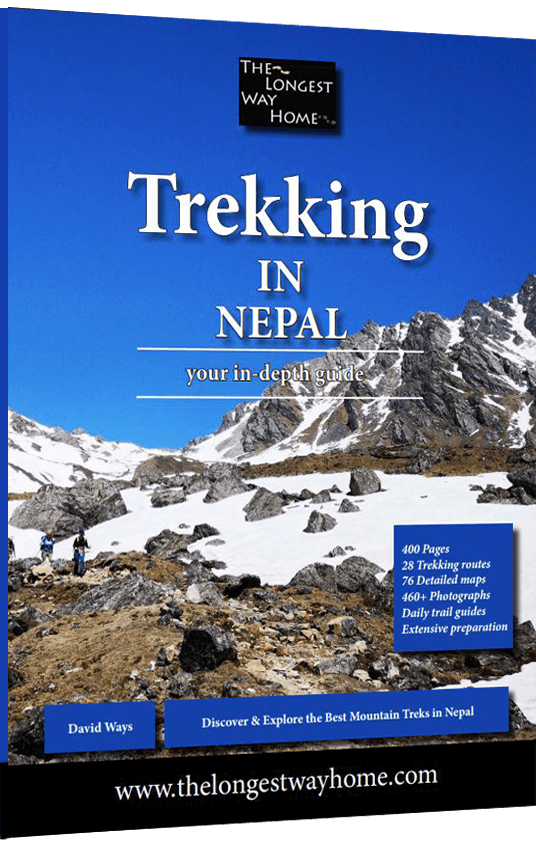
- Choose Your Format: High-res Digital or Print edition.
- Scalable Maps: Works offline with zero data or GPS.
- Real-World Logistics: Accurate costs and updated safety rules.

- Complete Country Coverage: Kathmandu, Pokhara, Chitwan, heritage walks, and culture.
- Includes First Time Trekking: The entire beginner trekking guide is included right inside!
- Offline Interactive Maps: Zoomable maps and walking tours for seamless navigation.