About Kirtipur
Just 5 kilometers from Kathmandu city lies a rocky hill where the ancient town of Kirtipur sits. Its name means "kirti" (glory), "pur" (city). While the main Newari area is on a hilltop, the town stretches to several neighboring villages.

Kirtipur makes an excellent choice if you would like to try some independent bus travel, being only a 25-minute ride from Kathmandu city. Thus, it's a great town to visit for a first attempt out of Kathmandu city by public transport.
Kirtipur can be visited in a half-day trip, making it an excellent choice to fill any time you have in Kathmandu. For a full guide to Kirtipur, do read my Nepal guidebook.
On this page
Kirtipur: At a Glance
Location & Getting There
5 km southwest of Kathmandu. 25 min by bus from Ratna Park area, 15 min by taxi from Thamel. Bus fare 35 NPR, taxi around 450 NPR to Naya Bazaar.
Visit Duration
Half-day trip works well. Easy add-on to a Kathmandu itinerary. Only 25 minutes from the city so no need to stay overnight.
Entrance Fee
100 NPR for foreign visitors, Nepalis free. Collected when the ticket office is open. Can be inconsistent.
Main Highlights
Bagh Bhairab Temple, Uma Maheshwar Temple, Chilancho Stupa, Tri Ratna Temple, Dev Pukku pond, Shri Kirti Vihara (the only Thai-style temple in Nepal outside of Lumbini).
Best For
Authentic Newari town with fewer crowds than Kathmandu Durbar Square. Ideal for a first independent bus trip from the city. Views across the Kathmandu Valley from the hilltop.
Information verified and updated: October 2026
Did you know?
You can view Kirtipur from Swayambhunath as it stands on a rocky outcrop above Kathmandu city.
History of Kirtipur
A former capital of the Kathmandu Valley, Kirtipur has always been a bit of a rebel. Its history dates back to 1099 AD when it was part of Patan. When King Prithvi Narayan Shah invaded the valley in the 18th century, Kirtipur broke away.
However, in 1767, Kirtipur was brought back into the kingdom following 23 attempts to conquer it by the King. On the 23rd attempt, one of Kirtipur's noblemen defected and was able to launch a final assault on the beleaguered town. These battles became known as the "Battle of Kirtipur".
In 2006, Kirtipur became the center for an uprising against the monarchy in Nepal.
What to see & do in Kirtipur
Whether you take a taxi or a local bus from the Ratna Bus area, you will likely be left by the local bus park at the bottom of Kirtipur hill.
 Chilancho Stupa
: Built back in 1515, the harmika is damaged at the top and sits awkwardly these days. Surrounding the Stupa are several brick and white chaitya. The front of the stupa is fenced in to protect against thieves stealing the copper work behind it. Be careful if visiting this area in the evening as there have been reports of aggressive street dogs.
Sadly, in early 2017, a vandal destroyed the Buddha faces around this stupa. It doesn't look out of place, but you can see where the faces have been removed. It looks to be more the work of a "religious vandal" than theft due to the close cutting of the stone.
Tri Ratna Temple is worshiped by both Hindus and Buddhists alike. It encompasses Buddha, Dharma, and Sangha. The temple took some mild damage in the 2015 earthquake. To the right down a street are two large golden Buddha statues.
Dev Pukku: Kirtipur's main water source, fed by underground water. To the tank's left is the very well-preserved former Royal Palace.
The Bagh Bhairab Temple is one of Kirtipur's main attractions. The courtyard is Kirtipur's finest. The main courtyard is filled with shrines and temples. It's worth having a look at a few as they are extremely unique. The temple is seeing increased local visitors in spring, so a morning visit works better if you want quiet.
 Uma Maheshwar Temple
is guarded by two elephants wearing saddles made of metal spikes (to keep people off presumably). The temple was originally built in 1663 with four roofs, but one was destroyed in the 1934 earthquake.
Shri Kirti Vihara lies at the bottom of Kirtipur and is the only Thai-style temple in Nepal outside of Lumbini. It is a Theravada monastery of the southern school of Buddhism and it was built in 1975. At the bottom is the main temple dedicated to the Buddha alongside a Thai-style pagoda. While to the right is a smaller building with several Buddhist murals and paintings. A small tea shop opened beside the monastery in late 2024, making for a cozy stop after exploring the complex.
Kirtipur hides more than the main courtyard. My Full Nepal Guidebook was the first to give Kirtipur its own dedicated chapter, with detailed maps for the old town streets, the temples, the viewpoints, and the small shrines most visitors walk right past. It also covers the whole country end to end, with the beginner trekking guide inside.
Kirtipur map
Map showing Kirtipur in Kathmandu
Entrance fee to Kirtipur
There is a 100 rupee fee for all non-Nepali visitors to enter Kirtipur. Collected when the ticket office is open, which can be inconsistent.
How to get to Kirtipur
Take a taxi for 450 rupees from Thamel to Naya Bazaar in Kirtipur, about 15 minutes. Then on the way back just hail one down in the same location or up at the base of the steps leading to the old town on the hill.
Buses leave every 30 minutes from Kathmandu's Ratna bus area for 35 rupees. It takes about 25 minutes. Do tell the bus conductor or driver that you want to get off at "Kirtipur - Naya Bazaar". On the way back it's the same bus stop, but the stop is across the road. In 2026 buses for Kirtipur leave on the road just south of Ratna Park.
Accommodation in Kirtipur
As Kirtipur is only 25 minutes from Kathmandu city there really is no need to stay there.
That said the one hotel in the area is not bad and makes for a good overnight getaway. The Kirtipur Hillside Hotel offers slightly dated rooms which are clean with various sizes to choose from. There's a restaurant on site with great views over the valley and a rooftop for even more views. I've already found the best price and you can book a room directly at Kirtipur Hillside Hotel.
Restaurants in Kirtipur
Kirtipur's restaurant scene is touch and go. During off-peak season, don't expect anything to be open in the old part of the city. Head to Naya Bazaar (where the bus leaves you off).
Newa Lahana: If you are looking for genuine Newari food surrounded by old village utensils and farming equipment, then this is the place you'll find it. Prices are inflated, which is a shame. Try the aloo (potato) dishes as a safe bet or Dal Bhat. Otherwise, give the spicy Buff Choila a go! (mains $4.50+)
Kirtipur Viewpoint Restaurant: Right beside the Uma Maheshwar Temple, you'll get spectacular views along with standard Chow Mein & Dal Bhat. There is some Newari cuisine on offer too, should the cook be inclined. (mains $3.50+)
FAQs about Kirtipur
Kirtipur is a historic Newari town known for its strategic location atop a hill. It is famous for its rich history, traditional Newari architecture, ancient temples, and stunning panoramic views of the Kathmandu Valley.
The easiest and most convenient way to get to Kirtipur is by taxi or ride-sharing service. It is a short drive from central Kathmandu. Public buses are a more budget-friendly option, with regular services running from the bus park near Ratna Park.
Key attractions include the Bagh Bhairav Temple, the Chilancho Bahal, and the Uma Maheshwor Temple, which offers a great viewpoint. The narrow, winding streets themselves are a sight to behold, filled with traditional Newari homes and cultural sites.
Get my Nepal Guidebook for the best in independent travel!
Articles are great, but 20 tabs open on the move isn't. In my guidebook I cover all attractions with well-researched information, photographs, itineraries, reviews, accommodation, restaurants, and travel-tested walking tours. It's an interactive and printable guidebook like no other.
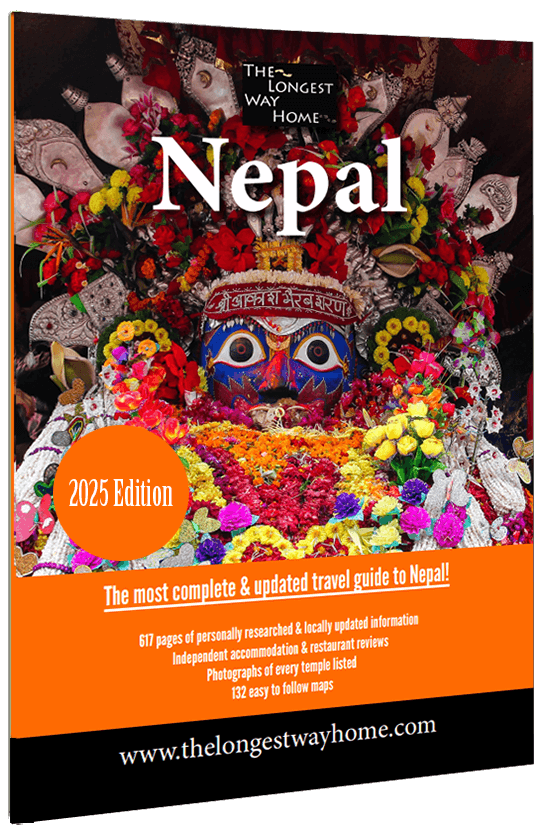
- Complete Country Coverage: Kathmandu, Pokhara, Chitwan, heritage walks, and culture.
- Includes First Time Trekking: The entire beginner trekking guide is included right inside!
- Offline Interactive Maps: Zoomable maps and walking tours for seamless navigation.
Was this page helpful to you? If so please tell others!