
The Reality of the 2026 Northern Floods for Travelers
On the morning of August 26, 2026, a catastrophic flash flood tore down the Bhote Koshi and Trishuli river corridors. Triggered by a massive high-altitude glacial collapse near the northern border with Tibet, a wall of mud, ice, and debris raced down the valley at terrifying speed, destroying roads, bridges, and infrastructure in Rasuwa, Nuwakot, and Dhading.
If you are reading international news reports right now, or social media, you are likely seeing broad, sweeping headlines claiming that "Nepal is flooded." As anyone who knows the country understands, that is a dangerously misleading generalization.
This disaster was strictly confined to specific northern drainage basins and transit arteries. Major tourism regions like the Annapurna Circuit, Everest Base Camp, Pokhara, Chitwan, and the Kathmandu Valley heritage sites are entirely outside the affected zone and operating normally.
Quick Facts
| Date | August 26, 2026 |
| Cause | High-altitude glacial collapse near the Tibetan border |
| Rivers | Bhote Koshi and Trishuli corridors |
| Districts hit | Rasuwa, Nuwakot, Dhading, Syabrubesi, Trishuli Bazaar, National Highway |
| Rest of Nepal | Unaffected, including Everest, Annapurna, Pokhara, Chitwan, and the Kathmandu Valley |
| Current status | Search, rescue, and structural assessments ongoing; northern frontier access restricted |
However, based on my experience and on-the-ground knowledge of disasters in Nepal, including this one, the situation is likely to become more grim. Expect a much higher number of dead or missing to be announced (we are seeing that today with more missing being announced). There will also be an urgency regarding health and hygiene in the coming weeks, as human and livestock remains cause issues. Similarly, large swaths of the affected area have had bridges washed out, cutting off supply routes, which may lead to some unrest.
Search and rescue work is moving forward, but access to the upper northern frontier remains heavily restricted while search operations and structural engineering assessments take place.
On this page, I cut through the panic and media noise to give you the precise, on-the-ground facts you need if you are currently traveling in Nepal, want to help, or are trying to evaluate an upcoming trip.
The most important distinction to keep in mind is the geography. A disaster in a narrow mountain gorge near the Tibetan border does not mean the entire country is impassable. Let's look at what is actually affected.
Did you know?
Major international outlets initially reported that hundreds of trekkers were missing, a headline that was inaccurate on several counts. Most of those people were not trekkers, but Kailash pilgrims travelling towards Mount Kailash in Tibet as part of the annual Kailash Mansarovar Yatra. There were also hundreds of Nepali visitors travelling to Gosainkunda to take part in the annual Janai Purnima festival, an important religious and cultural occasion.
This distinction is important, not because the safety of one group is more important than another, but because these groups were travelling in different circumstances and locations. Trekkers are generally spread along mountain trails, often independently and in remote areas. Pilgrims and festival visitors may travel in larger groups along established pilgrimage routes and towards specific religious destinations. Referring to everyone simply as "trekkers" therefore gave a misleading picture of who was affected, where they were travelling, and the circumstances facing search and rescue teams.
Where the Damage Occurred (and What Remains Open)
To understand how this affects travel, you have to look at the exact path of the debris flow. The destruction was concentrated entirely along the northern trade and transit corridor.
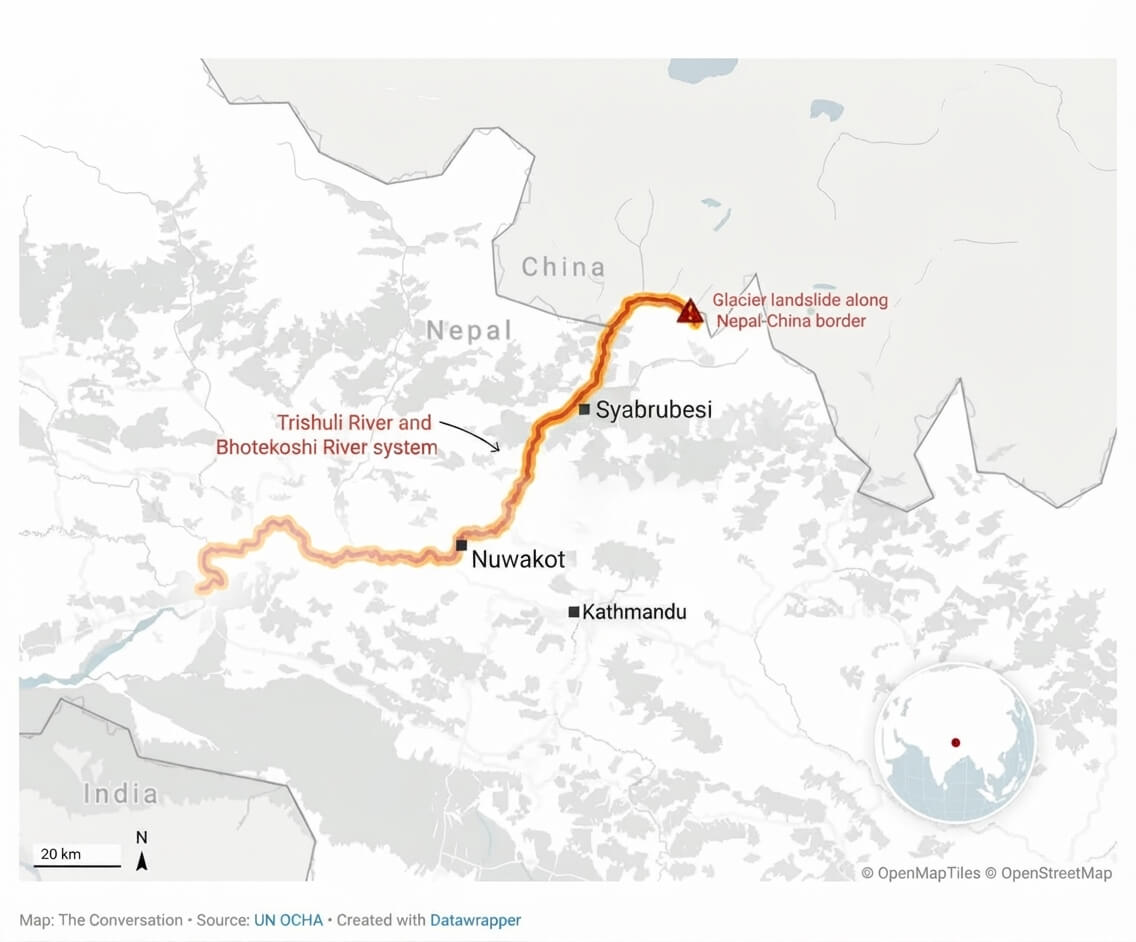
Approximate extent of the debris flow along the affected northern corridors
Settlements directly in the path, including Timure, Syabrubesi, Trishuli Bazaar and portions of the Rasuwagadhi border route, sustained severe impacts. Connecting mountain highways through parts of Nuwakot and Dhading also experienced temporary blockages and bridge washouts.
As you can see from the maps, the river corridors continue down through the country. There is localized flooding in these areas. Many are currently under repair in terms of roads and bridges. Outside of the main flood, it is monsoon season and local floods occur throughout Nepal. As an example, a road leading to the Annapurna Base Camp trek was damaged, and while the video taken of it seems traumatic, the reality is that it's just a 30-minute detour to get around it. Likewise some on social media are saying Chitwan is affected - Chitwan is a large region, and they are refering to an area far from Chitwan National Park or more commonly the town of Sauraha.
Classic trekking routes, with the exception of Langtang and Langtang Gosainkunda, are all open. Cultural tours and domestic flights across the rest of the country are running without interruption.
Current Travel Safety and Route Status
Local authorities and the Nepal Tourism Board have issued localized warnings urging people to steer clear of the Trishuli and Bhote Koshi riverbanks. If you are planning movement through northern districts, check conditions locally rather than relying on automated travel apps.
I will add to this and say to avoid or change your plans for Langtang and certainly Langtang Gosainkunda treks. The road to Syabrubesi is no more and Trishuli Bazaar has taken huge damage. It will take several months for rebuilding. While the road to Dhunche offers an alternative, it will add two or so days to the trek and full assessments on them have yet to be carried out.
As of August 30th a list of 38 trekkers that entered the Langtang Valley prior to the flood has been released. As communications are down, it is not known where exactly they are. However, it has been said that if they are still in the Langtang valley, which is likely, then they should be safe until infrastructure rebuilding allows them to leave.
Again, most tourists heading to Nepal, aside from Kailash pilgrims, would not be entering the affected areas in general. The exception would be the Langtang and Langtang Gosainkunda treks, or travelers heading to Nuwakot Durbar, which is currently under construction and sees fewer tourists in general. Again, there will be exceptions, but it's important context.
Status across major travel sectors:
While the northern frontier requires complete avoidance right now, the rest of the country's tourism infrastructure is intact. Here's the breakdown across popular regions:
Prithvi Highway – Krishnabhir
A section of the Prithvi Highway has collapsed in a landslide at Krishnabhir in Benighat Rorang Rural Municipality of Dhading, completely blocking the Muglin-Kathmandu section. Tourist buses will not be able to pass. Reconstruction is underway, and it will likely open in a few days.
Langtang & Ganesh Himal
The Langtang Valley trek is not affected, but the route leading to it is. The additional Gosainkunda leg should be avoided until infrastructure is repaired.
Rasuwagadhi & Tibet Overland Route
Closed to tourist traffic and commercial transport due to heavy infrastructure and bridge loss.
Everest & Annapurna Regions
Fully operational. These circuits sit on entirely separate drainage systems and saw zero impact.
Kathmandu, Pokhara, & Chitwan National Park
Operating normally. Hotels, domestic aviation, safaris, and city heritage sites are welcoming visitors as usual.
For verified, on-the-ground safety bulletins, always cross-reference official updates via official channels rather than sensationalized social media feeds.
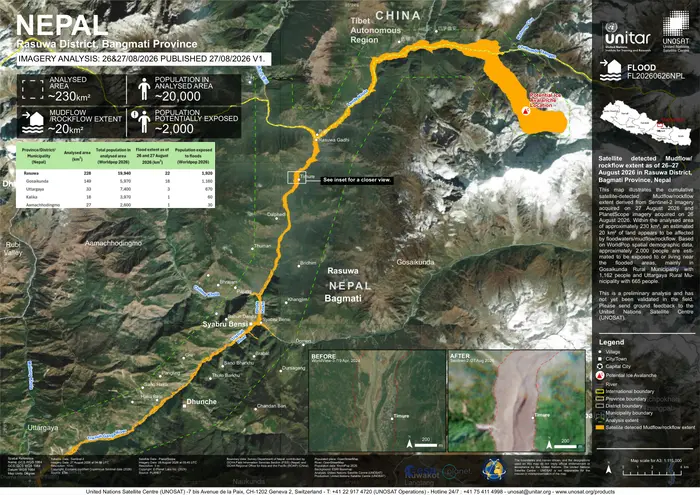
Satellite-based mudflow and rockflow extent for Rasuwa district, imagery dated 26–27 August 2026
The above map from Reliefweb shows another perspective of the flood zone.
What Current Visitors Need to Do Right Now
If you are already on the ground in Nepal, keeping a level head and relying on local, direct communication channels is your best defense against misinformation.
Practical rules for travelers currently in-country:
- Stay Away from Fast Rivers: This is normal advice during the monsoon season and the post-monsoon weeks. Currently, maintain a wide distance from major river systems like the Trishuli, regardless of how calm they appear downstream.
- Verify Before Booking Overland Transit: Check highway conditions directly with your hotel desk or independent transport provider before committing to long-distance jeep or bus journeys.
- Register Your Itinerary: If you are heading into remote hill or mountain districts, ensure your embassy or consulate has your current whereabouts. Make sure your friends and family know your itinerary, and remember to sign in at your accommodation.
Keep essential emergency numbers saved, including the Tourist Police (1103) and your national embassy helpline.
Again, most of this is general travel precautionary advice and not specific to the floods. However, most people don't follow it.
Advice for Future Travelers Planning a Trip
If you have an upcoming trip scheduled for Nepal's autumn or winter trekking season, there is no reason to panic-cancel your plans based on distant headlines. The exception for now is if you were planning the Langtang treks - at the moment it would be best to avoid them so infrastructure can be rebuilt.
Dealing with Tourist Guilt
I've had several messages from upcoming travelers worried about conditions, and dealing with guilt about visiting a country currently suffering a natural disaster. I know what that's like, both now and in the past with catastrophic events like the 2015 earthquake.
The reality is Nepal's tourism sector is already struggling. Coming anyway not only provides the usual economic support, it also shows something just as important: moral support. It shows that Nepal is not forgotten or abandoned. Ninety percent of your trip will likely see no flood-related events. The other ten percent may well just be how Nepal looks to many first-time visitors. There's a bustling, frantic energy in Nepal that may seem different to many new visitors; that's just how Kathmandu is. The further away you get, the quieter and more laid-back things get, until you encounter a festival.
My best advice is to push aside any form of guilt you may have, for whatever reason, and embrace the country. By just being there you are showing people that you care, you are supporting them directly or indirectly, and that you are not swayed by some of the crazy social media posts out there. You are showing that you did not abandon your plans or the people of Nepal. And again, your well-earned money for your holiday will be supporting the local economy.
Everything Is Open
The vast majority of Nepal's trekking trails, cultural towns, and wildlife reserves are entirely unaffected and depend heavily on responsible tourism to support local families during the recovery period.
Yes, things like a road closure on the National Highway going to/from Kathmandu /Pokhara/Chitwan is currently ongoing, but so too are repairs. Believe it or not, the Mugling Chitwan/Kathmandu road suffers from closures throughout the year. And, buses are taking detours. For the next month, there will be 3-4 hours added on to this journey.
There will be sensationalized social media posts and all the more if there's a late monsoon downpour. Context is vital.
On August 31st there was "regular" landslide in Tsum Valley - however, the context is that it was not on the trekking trail, and in an area known for landslides. Yet, social media is making it out to something completely different.
Future visitors should simply verify whether any regional conservation permits or access roads into northern border valleys require itinerary adjustments. Speak directly with independent local guides, trekking agencies, or tour companies who know the terrain intimately.
Relying on firsthand research and up-to-date sites like this, rather than generalized foreign media reports, will give you an honest, realistic picture of travel conditions on the ground.
What you are likely to see in the coming weeks and months
Higher Death Toll
Authorities are expected to release significantly higher numbers of confirmed dead and missing as search teams reach more remote settlements along the affected corridors.
Days of Mourning
National and regional days of mourning are likely to be declared, with flags flown at half-mast and public ceremonies held to honor those who lost their lives.
Health & Sanitation Warnings
Public health alerts will intensify across affected districts as authorities work to prevent outbreaks linked to contaminated water, animal carcasses, and disrupted sanitation systems.
Some Road Delays
Tourists should expect "some" delays on the National Highway routes e.g. Kathmandu to Pokahra, Kathmandu to Chitwan tourist bus route. Parts of the highway around Mugling have been damaged due to erosion and are under repair (this also happens post-monsoon season). As such expect delays of 2-5 hours depending on the day. Ask when buying a ticket to know what delays are expected.
Mass Burials & Cremations
Large-scale burial and cremation ceremonies will take place as bodies are recovered. Local communities and religious groups will coordinate these solemn rites.
Calls for More Aid
Humanitarian appeals will expand as the scale of infrastructure loss becomes clear, with international agencies and NGOs calling for additional funding and supplies.
Aid Distribution Controversies
Disputes over the fairness and transparency of aid distribution are likely to emerge, along with debates about rebuilding priorities and who should oversee reconstruction efforts.
Simple Rules for Travelers During Recovery
Natural disasters test mountain communities deeply, and tourist behavior matters immensely while local infrastructure undergoes repair. Maintaining situational awareness and respecting regional sensitivities is essential.
Keep these guidelines in mind when moving around the country:
- Do check local transit and weather conditions daily
- Do not try to go an volunteer to help - trained professionals are already there
- Do not dontate money to YouTubers or "influencers", see below for offical places to donate
- Do support independent local lodges and community-run businesses
- Do not attempt to bypass official police checkpoints or enter closed zones
- Do not spread unverified rumors or panic on social media
- Do be prepared for more grim news in the coming weeks
- Do respect instructions issued by local district administration offices
- Do learn some Nepali to help build direct, trusting local connections
Why independent, localized information matters
The biggest mistake tourists make during a regional disaster is assuming that a localized event defines an entire nation.
When a northern river gorge experiences a flash flood, international media often paints a picture of a country brought to a standstill. In reality, life, trekking, and travel continue smoothly across the rest of the country. Yes, there will be national mourning, but people will be happy to see you.
Getting your facts straight from people who actually know the country, rather than mass-media aggregators, keeps your travel planning realistic. For independent, thoroughly researched travel planning and precise regional insights, consult the up-to-date guidebooks and websites. Trusting firsthand field knowledge ensures your journey remains safe, independent, and rewarding.
Where to Get Unbiased News About the Floods
Much like the 2015 earthquake, perhaps more so, I've been shocked at international mainstream news coverage of the floods. There's been an incredible disconnect, and a strong reliance on clickbait headlines. This time around, social media and AI have added more fuel to the frenzy. I'm personally avoiding both in relation to the floods. I expect it to get worse in the coming weeks as the flood aftermath begins — e.g., burials, hygiene, transport issues, etc.
The following sources are local to Nepal and paint a different picture.
Without being political, I'll say that Nepal's Prime Minister has posted on Facebook about what's happening in clear, bullet-point lists. It brings a lot of context compared to the frenzy of the news headlines. The only issue is that it's in Nepali (you can use a translation app or browser), and it's on Facebook, which means he'll likely be mentioning other things too. Here are two examples of factual flood recovery reports from him:
The other two sources of news I'd suggest are Nepal's two main media outlets: The Kathmandu Post and The Himalayan Times. Both sites cover all of Nepal, and it's somewhat stabilizing to see that the rest of the country is moving on with things even as disaster recovery is taking place.
Those wanting to report a missing trekker can do so via the form on MissingTrekker.com. With respect to missing persons, if you are considering posting about a missing trekker in Nepal, please use the search and rescue contacts on MissingTrekker.com first, e.g., the Tourist Police of Nepal. Further, due to the sheer volume of people filing reports, and the actual purpose of MissingTrekker.com, I would respectfully ask that only those who were trekking, along with details on where they were trekking, should be reported on MissingTrekker.com.
Anything major and I'll be providing updates via X and Bluesky. Most of what I post is on-the-ground facts rather than sensationalized news.
How to Help
Do not donate to unknown people or organizations. Media and social media are filled with people soliciting donations. The same happened during the 2015 earthquake, with hundreds of millions of USD unaccounted for.
The Nepal government has cracked down on this during the flooding, saying that nobody can accept donations for flood relief other than the government. While that may sound heavy-handed, they are simply trying to stop people from profiting off the disaster.
Personally, I'm of two minds about this. The current government is new, and not the same as the previous one. I'm still waiting to see some transparency in the donations to the Prime Minister's Disaster Fund, but it looks positive so far.
Official Online Portals
- Global Online Portal: pmdrf.nchl.com.np (accepts domestic and international Visa/Mastercard, mobile banking, connectIPS, wallets, Alipay+, and UPI-India / Fonepay QR codes)
- Alternative Gateway: pmrelieffund.himalayanbank.com
Important Safety Advisory
The Prime Minister's Office has formally urged the public and international donors to verify account names closely. Contributions should only be made to accounts explicitly titled Prime Minister Disaster Relief Fund or PM Disaster Relief Fund, and donors should be wary of unverified or personal QR codes circulating on social media.
The other organisation in Nepal that I know does good work is the Nepal Red Cross.
Frequently Asked Questions about the 2026 Nepal Floods
Yes. Kathmandu, Pokhara, and all major tourism hubs outside the northern disaster zone are functioning completely normally, with hotels, restaurants, and domestic flights running without disruption.
Check official notices for individual treks, consult your accommodation provider or independent local agency, and verify transport status directly before setting out on any overland route.
Was this page helpful to you? If so please tell others!