
Table of Contents
» History
About Bungamati
Bungamati is one of the oldest and most important townships in the Kathmandu Valley. Located to the south of Patan, it was once called “Bungapatan”. The name “Bunga” literally means “old” or “ancient,” and “Bungaa” means a watering place. Sadly, the 2015 earthquake shattered most of this old town’s living quarters and sacred sites. Restoration has for the most part been completed.

The central attraction in Bungamati is the tall Shikhara-style temple that was said to be the home of the god Machhindranath and also where the Machhindranath Chariot id kept for six months of the year. The second attraction id the Bhairab temple in the same square, which keeps one of the most exquisite statues of Bhairab. Both have been restored.
Today, the main square in Bungamati is nearly-complete; the Rato Machhindranath and Bhairab temples, along with some of the surrounding homes in the square, have all been restored. If you really wish to visit a culturally important location that many tourists think is no longer standing - then Bungamati hits all the off the beaten path cliches in the world. Moreover, locals will be thrilled to hear you visited one of the most important Newari towns.
Quick Look to See If You Would Like Bugamati
Interests: History, Rebuilding, Less Tourists, Uncovered Corner |
Accommodation: Kathmandu or Patan |
Nearby: Kathmandu/Patan |
Time Needed: Half-day |
Hidden Insights
Uncovered Corner:
Bungamati Village
Why is this an Uncovered Corner? One of the valley’s oldest Newar towns, home to Rato Machhindranath (god of rain) and the lesser-known Fourth Kumari—Bungamati was devastated in 2015 but quietly rebuilt. Most tourists still believe it’s “destroyed,” leaving the restored square, Bhairab shrine (with rare statue glimpses), woodcarving streets, ponds, and hilltop Karya Binayak Temple in blissful peace.
Responsible Travel
Travel with Purpose: Go Deeper. I advocate a half-day visit to Bungamati by local bus or taxi—buy woodcarvings directly from artisans, respectfully observe daily life around restored temples, and chat with locals proud of their rebirth. Your presence rewards a community that rebuilt without mass tourism, keeping ancient Newar traditions alive far from the crowds.
History
There are many legends surrounding the origins of Bungamati, but most surround the “giver of rain,” Machhindranath. It is said that in ancient times, a great twelve-year drought devastated the Kathmandu Valley. King Narendra Dev from Bhaktapur sent a priest to find Machhindranath in Assam, India, and plead for his help.
The priest enlisted the help of a farmer and a naga for protection as he sought to wake Machhindranath from a deep meditation. Machhindranath awoke, and despite pleas from his mother, he agreed to help. Turning himself into a black bee, he flew into the golden vessel of Bandhudutt. Bhairab demons were asked to help on the return journey to the Kathmandu Valley.
Near the Nakkhu river, during a ceremony, the black bee was set free, and Naga serpents created rainfall over the drought-parched land. Upon seeing this, the god Bhairab shouted “Bu,” which means “home”. Bungamati town was then founded with the golden vessel Machhindranath traveling being enshrined inside the new temple of Rato Machhindranath.
Bungamati Square & Heritage Walk
The central square restoration is obvious as you enter Bungamati through the white gates. The area can be scattered with both scaffolding, bricks, and tarpaulins. The surrounding mud-brick buildings have largely been restored or replaced by concrete buildings. Though at the rear of the complete many remain cracked and in various states of damage. Care should be taken when walking close to them.
Rato Machhindranath Temple

The tall Shikhara-style
temple is rumored to have been constructed in the 17th century.
It has a white corncob-shaped central building with four smaller
and similar shapes at each corner. The earliest known
inscription in the area is from 605 CE.Inside the temple was the
red “Rato” Machhindranath statue. To Buddhists, he is the
tantric edition of Avalokiteshvara, while to Hindus, he is a
manifestation of Shiva. So the temple and statue hold great
significance to both.
The statue used to stay six months
of the year here and six months in the Machhindranath Temple in
Patan. Following the 2015 earthquake, the temple was completely
destroyed. The Nepali army rescued the statue and took it for
safekeeping.
Following the 2015 earthquake, the temple was completely destroyed. The Nepali army rescued the statue and took it for safekeeping. Today, renovation work is still not complete, but likley by the end of 2026.
Bhairab Temple (Hayagriva Bhairab Shrine)
Previously, the two-story pagoda-style Bhairab temple had been restored in 1850 and again after the 1934 earthquake. During the 2015 earthquake, the temple completely collapsed. The restoration was completed in 2023. The temple is nestled up a set of stairs in the south-east section of the courtyard behind the Rato Machhindranath temple. It houses an important gold statue of Bhairab that is rarely seen in public.

The statue was saved from the temple ruins following the earthquake. If you walk up the steps that lead to the temple, you’ll see a locked door guarded by the Nepali army. Inside is the Bhairab statue. Although it was rarely seen previously, its new location means you can catch a glimpse of it through the guarded door. Asking the soldier on duty helps a little!
The shrines left standing in Bungamati’s main square are made of some small chaitya, a white shikhara-style domed shrine to Ganesh, and a metal-roofed pavilion. Behind the Ganesh shrine, there’s a small woodcarving museum, but it is not always open. Walking back around to the front of the former Rato Machhindranath temple, there’s a pit surrounded by butter lamps. Further along, there’s a small sunken hiti.
Opposite the stone lions is a red-bricked archway where you can pass through to visit the rest of Bungamati.
The Fourth Kumari
Kathmandu, Bhaktapur, and Patan, in that order, are all renowned for having a Kumari Living Goddess in residence as per their importance. Bungamati is lesser known for being the home of the fourth Kumari. The goddess Durga resides in the prepubescent girl, who is chosen among many. In Bungamati, you may have a good chance of meeting or seeing the fourth Kumari.

Walking down the steps from the archway opposite the Rato Machhindranath temple, follow the street to the right. There’s a two-story building opposite some small shrines. The fourth Kumari doesn’t have as many strict rules to follow as the other Kumaris and often attends school, so they may not always be present. It’s along this street that you may find some traditional woodcarvers at work. Should the Kumari change, asking locals along this street will likely yield you the location of the new living goddess.
Old Ponds, Hitis & The Amarapur Buddhist Learning Center
Depending on the time of year, the pond will change color based on the algae levels. It’s a nice area to watch local people at work, as they often use clay pots to collect water and dry reeds around the stone boundary.
Continue along the street until you pass through a gate. Cross over the road, and you’ll come across two more ponds that are not so well kept. Up ahead is the Amarapur Buddhist Learning Center. Visitors are welcome to visit the learning center, meditate, or study there. Rooms are also available for about 500 rupees for students of Buddhism. English is not widely spoken here, and the facilities are minimal.
Karya Binayak Temple

From the learning center turn back to the main road and take a right, so you are now walking north. The dusty road winds its way down through the remaining town, along with small stores and some rice paddies. At the next junction, take a left, and the road starts to incline before an old school hall, where you can veer off to the left again.
Continue walking along the path until it finally opens up with a small red brick shrine and a set of steps leading up to the Karya Binayak Temple. Admission: Free
The Karya Binayak Temple is dedicated to Ganesh, and while it may look like a simple single-roof pagoda, it holds a lot of importance. Most Saturdays, devotees come here for a celebration of food and traditional music. The temple is rather unusual within the Kathmandu Valley, as much of the surrounding fence and temple area are covered in little brass bells. The views of the Kathmandu Valley on a fine day from this fence are quite beautiful.
Inside the temple is a stone shrine to Ganesh. However, if you walk clockwise around the temple to the left, there’s a detailed brass Ganesh relief embedded into the ground.
Accommodation in Bungamati
Given that Bungamati is so close to both Patan and Kathmandu, coupled with the earthquake damage in the surrounding area, most people elect to stay elsewhere. If you do want to stay in Bungamati, try the Amarapur Buddhist Learning Center, which has rooms for 500+ rupees.
Restaurants
There are no tourist-specific restaurants in Bungamati. You will find the odd local sweet shop and corner store, but that’s about it. Bring snacks!
Getting There and Away
Take a taxi for 1000–1200 rupees from Thamel to Bungamati. Unless you intend to take the bus back, you might consider having the taxi wait, as there’s little chance of finding another on the way back.
From Patan, you can easily get a taxi for about 600 rupees one way. Buses depart from Kathmandu Ratna bus area, costing 50 rupees for the 1-1.5 hour trip. From Patan, you can catch a bus for 30 rupees for a 40-minute journey.
Map to Bungamati
Frequently Asked Questions about Bungamati
The Rato Machhindranath Temple, rumored to date back to the 17th century with inscriptions from 605 CE, is a significant religious site in Bungamati. It housed the red “Rato” Machhindranath statue, revered by Buddhists as the tantric Avalokiteshvara and by Hindus as a manifestation of Shiva. The statue, historically kept in Bungamati for six months each year, is central to the annual chariot festival, symbolizing the town’s role as the “home” of the rain god Machhindranath.
The 2015 earthquake devastated Bungamati, completely destroying the Rato Machhindranath Temple and the Bhairab Temple. The Rato Machhindranath statue was rescued and relocated to Patan, while the Bhairab statue was saved and is now housed in the restored Bhairab Temple, completed in 2023. Restoration of the Rato Machhindranath Temple is ongoing but delayed, with a target completion date of 2025.
The Fourth Kumari is a prepubescent girl in Bungamati believed to embody the goddess Durga, making her the fourth Living Goddess in the Kathmandu Valley after those in Kathmandu, Bhaktapur, and Patan. Unlike other Kumaris, she has fewer restrictions and may attend school, increasing the chance for visitors to see her near her residence, a two-story building opposite small shrines along a street from the main square.
Currently, there is no entrance fee to visit Bungamati’s attractions, including the Karya Binayak Temple and the central square. However, this may change in the future as restoration efforts progress, particularly for the Rato Machhindranath Temple.
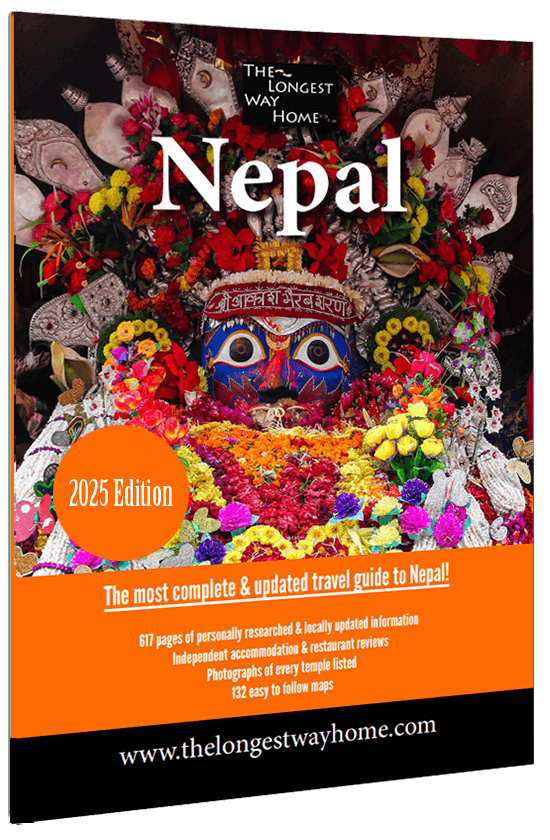
Discover Nepal Like Never Before with My Guidebooks
If you've enjoyed this page, you're going to fall in love with my guidebooks! They offer comprehensive coverage of all attractions, complete with well-researched information, high-quality photographs, detailed itineraries, expert reviews, and curated lists of accommodations and restaurants. Plus, they feature travel-tested walking tours that will enhance your experience.
My guidebooks are not just books—they're interactive and printable, designed to accompany you on your journey through Nepal.
|
|
|
Full Nepal Guidebook Available in paperback and digital formats. |
Kathmandu Valley Heritage Walks Available in paperback and digital formats. |
Was this page helpful to you? If so please tell others!