
Nar Phu Annapurna Circuit – Day 12 of 15: Rejoining the Classic Annapurna Circuit from Shree Kharka to Letdar
Before looking at today’s descent from Shree Kharka back to the main trail, I want to acknowledge the reality of publishing this during a national crisis. While this post documents a remote, high-altitude trail far from the affected river corridors, it feels strange to share my trek while friends and communities deal with devastating loss. It’s not the first disaster in Nepal I, or we’ve, been through. The reality is Nepal needs help right now, and like it or not tourism helps. Nar Phu and the Annapurna Circuit are physically unaffected by the floods, along with the majority of destinations in Nepal. I am keeping this series moving as scheduled, with my flood updates linked above. I’m also helping with MissingTrekker.com which has largely moved to a small volunteer support base helping people get and find information. None the less because this Nar Phu Annapurna Circuit is a record of the trails as they stand, it also indirectly helps communities and trekkers heading there. Meanwhile my Nepal Floods 2026 page has the latest information for tourists.
Today is about trekking logic and pacing. Though on reflection, as I edit, being back on the main circuit seems to affect me more than the trail. After two days around Tilicho Lake, Gautum and I descend from Shree Kharka to rejoin the main trail of the Annapurna Circuit. For those following the Road Free Nar Phu Annapurna Circuit itinerary, this is Day 12.
Our goal today is Letdar at 4,200m. While many trekkers stop an hour earlier at Yak Kharka at 4,050m, drawn in by the name alone – Yak Pasture is admittedly a good name for a trekking stop, sorry Pisang. I favour the extra push. Every meter gained today is a meter not needed tomorrow during the ascent to High Camp. Though I’m all in favour of saving energy today as I’m tired. It happens. We’ll trek on today, and so save time tomorrow.
Usually I’m better the longer the trek, but I think the “emotional weight” of seeing so much of the old Annapurna Circuit gone, and then repairing it with a new trek is catching up to me.
It doesn’t help that Nepali policies contradict any good work done by independent trekkers or writers documenting it. Instead of pushing for new trails beside or behind roads, they are pushing for more road tours to combat the decline in tourism by satisfying local and regional tourists and those who will pay for jeep tours over trekking. Yes, the politically correct armchair gurus will be up in arms. But the reality is, attend any tourism conference in Nepal and you’ll be told “adapt to the new demographic”. The issue is it’s not a new demographic, it’s the fact that policy has wiped out the trails so they have pivoted the demographic to jeep tours. The jeep tour companies are well connected just like the helicopter companies, fewer, and the financial rewards are greater for a select few rather than spreading the tourist income over multiple local teahouses and local trekking guides.
The funnel they are advocating is narrow and feeds only a fat few. While trekking on the other hand brings about independent trekkers, putting money directly into the hands of local people, local businesses, and local producers across a wide spread – that is not seen as easy money for the wealthy operators to capture.
Someday the jeeps will stop rolling as AI makes video of the trails so you don’t even need to be there. Or will have a personal drone bring you live coverage … what then? That’s my morning rant over (not really). But yes, it shows that tiredness on a trail isn’t always about physical demands.
The Ghost of Upper Khangsar and the Yak Patrol
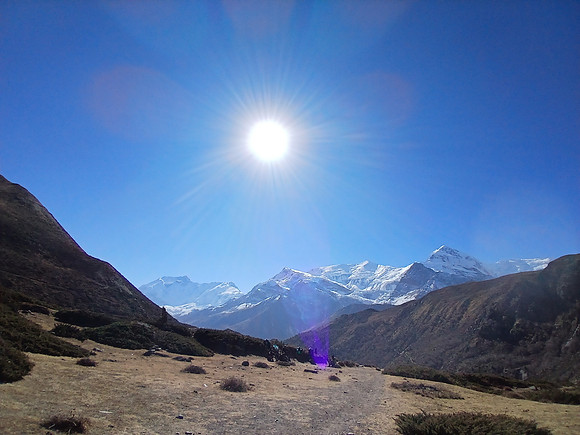
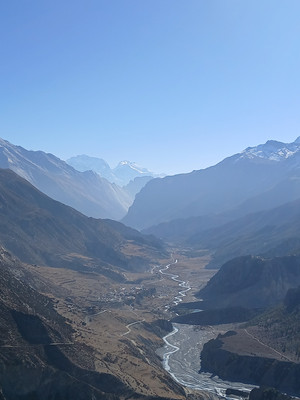
The morning began with a climb toward Upper Khangsar, a second settlement sitting above the main village, largely abandoned now. It is a hauntingly atmospheric spot that offers a clean split perspective: looking back, the deep valley drops toward Manang; looking forward, the white wall of Tilicho Peak fills the horizon. Worth a moment of standing still, which is free of charge.
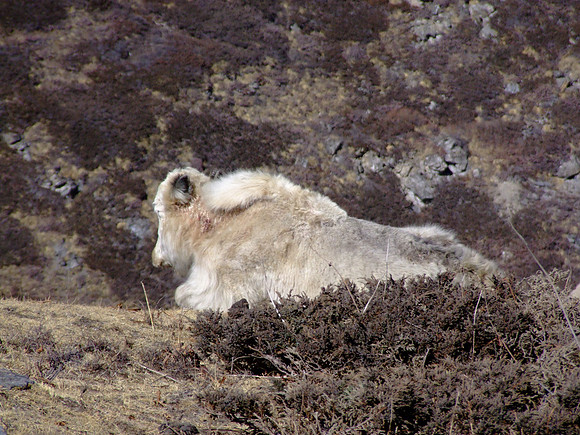
Progress was interrupted by a large herd of yaks and several dzos blocking the trail in that particular way large horned animals have of making a path feel suddenly very narrow.
To the uninitiated, a ton of muscle and horn at close quarters can be unsettling. In practice, these high-altitude residents are generally more moody than aggressive, and the correct response is to move slowly around them on the uphill side and not make sudden movements. The incorrect response, which I observed from a trekker behind us, is to attempt to pet one while someone else takes a photograph. This will end badly eventually. The headlines will be predictable when it does. I write guidebooks, I don’t tell people what to do – though sometimes, like this case, it would be nice.
The Trekking Kitchen: Why The Right Lunch Matters
We stopped for a late lunch in Yak Kharka and witnessed a scene I have seen many times over twenty years throughout all treks in Nepal, though it never stops being instructive. A group of trekkers had ordered momos and sizzlers and were visibly frustrated with the kitchen. The wait had passed one and a half hours. One of them had opened ChatGPT on their phone, apparently to look up how momos are made.
We watched them from across the room as technology invaded our mountain paradise. The AI provided a confident explanation of momo preparation that was accurate for a restaurant in Kathmandu or London. It had absolutely no frame of reference for a teahouse kitchen at 4,050m with one gas burner, limited flour, and a home cook managing five different orders simultaneously. Gautam and I exchanged a look and said nothing. Some lessons are better absorbed through waiting.
I’ve written about this so often I do wonder if anyone reads anymore. If I red flag it, a Facebook Group or TripAdvisor Guru will lambast it as over reacting. At the end of the day it’s up to a trekker if they want to heed advice from a guidebook or not. For what it’s worth, here we go. Ordering complex food for lunch above 4,000m is a mistake, because it affects everyone in the kitchen queue behind you:
- The Labour: Mountain momos are made from scratch. Rolling dough, preparing filling, and steaming takes 60 to 90 minutes in the best conditions. There are no frozen batches up here.
- The Same Problem Applies to Pizza and Roast Chicken: Anything requiring an oven or extended cooking time belongs on your evening menu, not your lunch order. Save those for when you are staying the night and the kitchen has time.
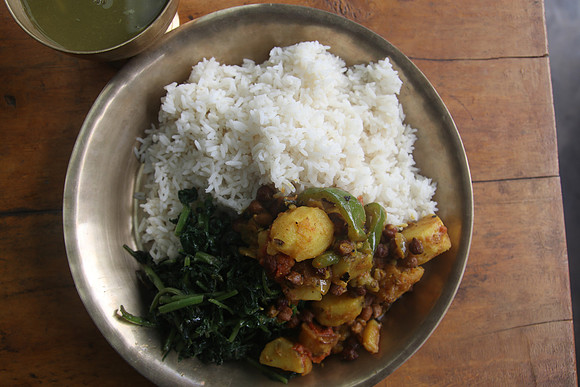
- The Fuel: Above 4,000m, dal bhat is the correct answer. It is almost always ready to serve, delivers the complex carbohydrates the body needs for trekking, and every teahouse makes it slightly differently. It is genuinely never boring. Unless you dislike rice, which I do. But, with dal I find it all manageable and certainly filling.
- The Health Factor: Avoid cheese and if possible avoid meat at these altitudes. Without reliable refrigeration, the bacteria count in local cheese and meat can end a trek faster than a sprained ankle. Cheese momos belong at the victory dinner in Pokhara or Kathmandu, not at a mountain lunch stop.
I’m a carnivore, I hate thinking about no meat – I make do with eggs, and I’ve yet to ever have a bad stomach when trekking in Nepal
Gautam and I finished our dal bhat while the momo group were still waiting for their dough to steam. Over lunch we had a quiet conversation about the general state of preparedness among trekkers these days. Not unkindly, but honestly. The ChatGPT moment crystallized something we had both been noticing. There is a growing gap between the information trekkers arrive with – much of it sourced from AI tools, influencer videos, and forum posts – and the practical reality of what this terrain actually demands. An AI can tell you what a momo is. It cannot tell you that ordering one at 4,050m on a one-burner stove at noon will cost you nearly two hours and irritate an already busy kitchen and hungry trekkers behind you in a queue. That kind of knowledge comes from being here.
Gautam still insists the best dal bhat on the entire trek so far was in Meta. I remain a Phu partisan. Neither of us needed an algorithm to work that out.
All the same I do say, “I will tell your wife that you think the best Dal Bhat in Nepal is in Meta!”
Guatum laughs out loud. He knows I’m joking, and yet he also knows that when we are back in Pokhara having dinner at his house I will say just that! His wife will scold him, he will make excuses, I will say his wife makes the best Dal Bhat in Pokhara, he will say I said Phu, and we will all laugh.
To me, this is trekking. Not staring at a phone.
The Transition to Letdar
Rejoining the main circuit trail after the Tilicho detour produced a mild culture shock. The path widened, the maintenance improved, and the number of trekkers around us roughly tripled. We left the momo group still waiting in Yak Kharka and pushed the final hour to Letdar. I also figured out why I was tired. It may be about the emotional weight of repairing the Annapurna Circuit, but greater than that is the weight of “Is anybody listening?”
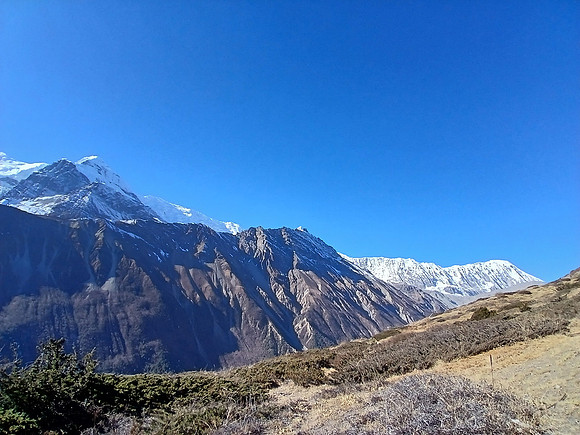
The scenery on this stretch shifts into a crisp high-alpine palette fit for an oil painting. A descent into a neighbouring valley before the final climb to Letdar produced some of the most vibrant colours of the entire trek – ochre slopes, green scrub along the river below, and the white peaks sitting hard against a deep blue sky. We reached the lodge feeling, if not fresh, then at least satisfied. There is a difference.
By staying in Letdar rather than Yak Kharka, tomorrow’s walk to Thorong Phedi or High Camp is shorter by a full hour. I’ll sleep well knowing that. On a day that will already be long and cold, that extra hour saved is nice. We also seem to have left the crowd behind us.
I turn in for the night thinking about the day of reflection. Jeep tours in the Annapurna’s, inept policies, and trekkers that don’t seem to be able to think outside what their phones tell them. Have I lost the plot, or spent too long outside the modern world, or is this the reality of today’s world?
For the full Nar Phu Annapurna Circuit itinerary and food advice for high-altitude trekking, see my Trekking in Nepal guidebook.
Next: Day 13 – Letdar to High Camp: The final push before the Thorong La and what the night before a high pass actually feels like.
Get the Only Guidebooks Worth Reading
Most guidebooks are years out of date or filled with paid placements. My books provide a complete strategy for Nepal with 100% independent reviews. Get the exact costs for every meal, bed, transport, plus the world’s only vetted, scam-free trekking agency list.
 Trekking in Nepal |
 Nepal Guidebook |
Shocked and saddened by the floods in Nepal the past week. I went to your site and saw your Nepal page had a warning and it linked to the same flood page you did here. Thank you for always being on top of things. The international news was awful and you brought it back to reality!
Glad you are safe David!
I read your flood page from the newsletter and it was grounding and shocking and everything in between. Then this post and everything has vanished from new headlines yet here you are!
Yes, it seems like 7 days after the disaster international media just dropped the story. The reality is, it will take most of the year to resettle people, probably longer. Let alone put in place measures to help future disasters are less devastating.
I’m guessing this will affect tourism this year. Good to see you continuing on. It’s a small part of the country, but it’s a small country. Do you think people will stay away?
I’ve mentioned this a few times on the podcast and elsewhere. Tourism has dropped dramatically this year before the flood. I’m nearly certain they’ll blame the flood, for statistical purposes and keep things like incentives, loans, and all else going until next year. But unless Nepal’s tourism sector radically changes from the direction it’s going things will continue to decline. In terms of will the flood disaster stop people from coming to Nepal? Yes. Is the simple answer. Considering the state of the world, going on holiday these days costs a lot, and people want peace, quiet, enjoyment, and value. The psychological process runs into a hic up with Nepal with or without the flood. With the flood, even if nothing or nobody was affected, would be enough to turn many people off. Yes, there will be repeat tourists who know Nepal well, or those already booked and are up for an adventure. But again, Nepal’s pivot towards wealthy tours over independent travelers is one realization that hurts it in cases like this. And, that’s only one of the few reasons Nepal’s tourism sector is in more trouble than it’s letting on.
Shocked and saddened by the flood. I read your flood page and it just brings it all together so well. Then I read the tourist boards “all road networks are operating normally” and shock my head before coming back here. Are they mad?
Yes, I don’t know the thinking there. I think it was a knee jerk reaction when they realized people were cancelling en masse. Unfortunately, saying all major road networks are operating normally when the biggest network between Kathmandu and Pokhara did more harm than good. It basically reads like an outright lie, which to tourists means a break of trust and danger bells already ringing start to ring louder. Worse again is when they arrive and are told “better take a flight” so that $20 bus ticket becomes a $120 airfare (in a country with a bad flight record) and adding to this is that locals fly for half the price! Or take a private jeep at $150 with 5 hour delays. It would have been far better to say “national highway is under repair with alternative routes being put in place” – this lends tourists to reading open honesty with choices to get around. Better yet would be a mandate saying two-tier pricing is being stopped during this disaster to allow non-Nepal the same rates to travel. That could and would incentivize tourists that Nepal cared, and was making effort.
Good to see you continue on like this. The past week has been horrendous. Long term Nepal needs tourists to keep coming. A shame they’ve been pushing for wealthy tourists over budget the past number of years.
I agree. The upsurge during the elections of budget and independent tourists was needed. It could occur again now, but …
Came here for news about the floods and sure enough you were there. I thought what a small disclaimer at the top, then I read the whole flood page and was blown away as normal by your dedication to detail and honesty.
Thanks. I really was annoying by the initial media claims and saddened by the social media frenzy. Only brief mentions of the Kailash pilgrims, and Janai Purnima festival being the main reason for the high death tolls in terms of the locations when the flood hit.
What’s the Kathmandu to Pokahara road like at the moment?
See my flood updates page for the latest transport info on buses to and from Kathmandu Pokahra.
Microvans are taking people via Gorkha. On a good day it’s 8 hours Kathmandu to Pokahra, but on a bad day with traffic you can add on 3-5 hours.
Any thoughts on the early warning system they said should be in place to prevent this in future?
Honestly, it depends on how early such a system could alert people. At the moment some people are saying evidence was seen months ago about the glacier giving way. If true, then yes questions need to be asked. Also, how reliable would that early a system be, and the cost? If it’s an early warning system for a 30 minute warning of an impending flood etc then I’d have doubts it could be implemented properly across so many valleys, glaciers, etc. Aside from that, there would need to be emergency training for all those villages, sirens, telecom alerts etc.
I did not read anywhere else about the Kailash Pilgrims or the Sacred Thread Pilgrims, only on your floods page. Why would news outlets not cover that’s where most of the tourists were?
My understand is that mainstream media were told “tourists” and there was no breakdown as to the type of tourist. Some outlets mentioned trekkers. The issue, as I wrote, is multi-fold. Trekkers will be dispersed in different mountain regions, while pilgrims would likely be in one central location. Context like that is important instead of blanket terms. In many ways using the blanket term “tourists killed” or “tourists missing” with high numbers did damage to the tourist industry.
Just wanted to say thanks for the Nar Phu Annapurna Circuit posts. I know a lot is going on. But we are using them as an inspiration to go on that very trek this year. Maybe by doing so it will help the local people.
Yes, I felt it was important to continue on the Nar Phu Annapurna Trek. There are people going there this year after reading it hear and the work I put into the road free Annapurna Circuit. Areas not directly affected by the flood. So, it will help locals in the area to keep their businesses open. Similar to the 2015 earthquake when so many wrote Nepal off. Big headlines saying “Patan has been destroyed” so I literally went there and took photos showing it was not.
Glad to know you are also going!
What an incredible trekking experience! I really enjoyed the detailed account of the journey from Shree Kharka to Letdar. Reading about the changing landscapes, altitude, and everyday challenges along the Annapurna Circuit gives such a genuine sense of what the trek is actually like. These personal day-by-day stories are especially useful for anyone considering the route themselves. Looking forward to reading the next part of the adventure!
Thank you, glad you enjoyed it!